Showing posts with label Buyers. Show all posts

Monday, September 22, 2014

Anyone, Anywhere

You know by now that we are your local real estate resource. What you might not know is that we can help just about anyone, anywhere with their real estate needs. Buyers of vacation homes in other states, those relocating into or out of our state, anyone buying or selling real estate across the country even if their move has nothing to do with our local area – we can help them all.

How? In addition to our proven Regional Partnership model which has empowered us to create satisfied clients from Vernon Hills to Manteno, we have also facilitated successful relationships in Indiana, Wisconsin, Arizona, Florida, Wyoming, and more. As a member of the largest real estate company in the country with over 100,000 agents nationwide, we will do the legwork to identify a top-quality agent wherever you or your loved ones need service.


So next time ANYONE you care about has real estate needs, whether near or far, please don’t allow them to fall into the hands of a weak or average professional. Contact us and we’ll make sure they get superior service. Remember our motto: Friends Don’t Let Friends Hire Bad AgentsSM

Friday, December 6, 2013

Conventional Wisdom: Overturned

As conventional real estate wisdom has it, sellers should “wait until spring to list your house because there are no buyers during the winter.” Perhaps that was true at one time. If it was, it is no longer. Realtor.com just released a survey of winter buyers that was conducted last month and which shows some very different information. Here’s what they said…

-          When asked about the biggest challenges when searching for a home during winter, the most common answers were that there is not enough inventory within their price range (45 percent of respondents), and that there is not enough inventory on the market (34 percent). The biggest complaint was that there are not enough homes for sale.
·          
-          Among the top reasons consumers are looking to buy a home in winter? 24 percent revealed that they were unable to buy a house during spring or summer. The truth is, there weren’t enough homes for sale this spring and summer to satisfy demand. These buyers wanted to be in their next home by now and are way behind schedule. How would you rate their motivation?

-          If that’s not enough to make you reconsider waiting until spring, consider that 19 percent of those surveyed are planning to purchase this winter using all cash.

What we have then is a lot of buyers who couldn’t find a home during spring or summer, who are complaining there are not enough homes for sale during the winter, and a fifth of them are cash buyers. So if you’re considering selling soon, when would be a good time to do it? Probably right about… now.


Thursday, November 14, 2013

Getting Your Offer Accepted

As Bob Dylan, said, “The times, they are changin’.” Not too long ago, advice on this topic wouldn’t have been necessary. Since the beginning of this year, however, one of the biggest challenges buyers have faced is wrapping their heads around the fact that they don’t call the shots anymore. Inventory is way down across the board, and for the first time in a long time there are more buyers than sellers. So landing a great deal takes a bit more effort than it has in recent years.

As a buyer, there are certain things you seek in a home. Your needs are unique, but the general characteristics that make a home appealing within a particular area or price range are almost universal amongst buyers. That means you’ve got competition. More and more, well-priced listings are attracting multiple offers within days after hitting the market, and they’re selling for sometimes far in excess of the seller’s asking price. Even without multiple offers on the table, sellers of well-priced listings know if any given offer isn’t all that attractive, they can simply wait for the next one which should be arriving shortly. The seller has their pick of buyers, and it’s up to you to convince them you’re the one!

What sellers are looking for is NOT just the highest possible price, though – they’re looking for the best possible price with the highest likelihood of closing. So what can you do to make your offer more attractive than others?

 Price. Although price isn’t the only concern, it’s still the primary one. Offer high enough, and the other considerations fade out as dollar signs enter the sellers’ eyes.
Financing. Plain and simple, cash is king. Sellers frequently accept lower cash offers because their likelihood of closing is much higher than that of a financed offer. If you don’t have enough cash available, consider such creative methods as 401(k) loans, private mortgages (i.e. to a family member), or for investors, hard money. If you must finance, then use the strongest financing you can qualify for. In order, that would be:
a.       Conventional with 20% or more down
b.      Conventional with less than 20% down
c.       FHA with 10% or more down
d.      FHA with less than 10% down
e.       Rehab loan, such as FHA 203(k)
           Time. Typically, sellers list their homes when they’re ready to sell them. (Duh, right?) So the faster you can close, the faster they can move on with their lives. If you’re buying cash, you can probably close within two weeks. With conventional financing you can shoot for 30 days, and with FHA you’re looking at 30-45. Rehab loans take a minimum of 60 days and can easily drag on for much longer.
      Contingencies. The fewer contingencies, the better. Attorney review and inspection contingencies are built into the contract, but that doesn’t mean they can’t be waived/eliminated. If you must finance the purchase, then you must include a financing contingency – there’s no way around that. A sale of home contingency (you have to sell your house in order to buy the next one) significantly weakens your offer by extending the time frame and introducing a large amount of uncertainty. If you’re competing with other offers and you are contingent-on-sale, you’re very unlikely to win.
       Incentives. Additional personal property, closing cost credits, seller-paid points, home warranties, high tax prorations, pre-closing possession… These are just some of the “perks” buyers can, and frequently have, requested when making offers over the last few years. On top of nickel-and-diming the sellers with these items, they complicate the presentation of the offer. Author Les Brown said, “Shoot for moon. Even if you miss, you’ll land among the stars.” Sorry Les, but in this market if you shoot for the moon as a buyer you’ll likely just end up by yourself in outer space. Keep the perks to a minimum if you want the best price, or to get the house at all.
      Heart strings. Most sellers are human beings, and most human beings have emotions. In some instances, it can work in your favor to submit a “personal letter” to the seller to demonstrate why you love their home and how you’ll take great care of it for many years. When to include a personal letter is a topic for another day!

Here’s the rule of negotiations, of which I’m sure Yogi Berra would approve: Everything other than price costs money. Handing a briefcase full of cash to the seller on the spot is the surest, fastest way to complete the sale, and if you could do that, you would get the house for the absolute lowest price possible (although it’s probably not a great idea for other reasons). Anything beyond that – each extra step, each contingency, each week that must pass before closing, each nugget of uncertainty – must be accompanied by a higher price to compensate the seller for the additional risk. On the opposite end of the spectrum from the briefcase-full-of-cash buyer is the buyer who makes an offer contingent-on-sale, financed with a 203(k) rehab loan, a 90-day closing, and throw in the 1976 Eldorado that’s in the garage. This buyer would have to pay dearly in order for their offer to even be considered.


Keep these considerations in mind when you’re thinking about how to structure an offer. Better yet, hire an agent who can advise you as to how much you can ask for on any given listing while still getting a house you’ll love for the best possible price.

Tuesday, June 4, 2013

Are We in a Seller's Market??

Buyer's market, seller's market... Chances are, you've heard lots of people throwing these terms around without anyone within earshot actually knowing what they mean. Sure, in the general sense, a buyer's market is good for buyers and a seller's market good for seller's. But how, why, and what the hell does it actually mean? Now, I can't define these terms if you're curious about the market for methamphetamines, but if you're talking real estate, I've got you covered.

In the most general sense, for any product or service, one side's market is when there are more people on the other side of the fence than on your side. So a seller's market is when there are more buyers than there are sellers, which means a few things:
- Buyers have fewer choices
- Buyers run into each other more frequently, creating increased competition
- Due to the first two points, buyers find themselves making higher/better offers for any product that substantially meets their requirements, in order to beat out the competition and because there isn't much else to choose from. At the same time, sellers see this happening and price their products higher. These forces result in price increases. Swap the scenarios in this paragraph to envision a  buyer's market.

Ok, now back it up for a second. In order to define buyer's vs. seller's markets in real estate I have to offer a quick lesson in applied math, but I promise I'll keep it short! One of the useful measurements of a market is the absorption rate, which tells us how many homes are selling each month (the number of homes sold over a certain number of months, divided by the number of months). For example, in the past three months in Joliet, 243 homes were sold. So the absorption rate in Joliet over the past three months is 243 / 3 = 81, which means on average 81 homes sell each month. By itself this is not a great indicator of a market, because in Steger there are not even 81 homes available for sale. So to make the absorption rate mean something, we have to factor in the size of the area by dividing the absorption rate into the number of homes that are currently for sale in that area. For example, take Joliet's 577 homes currently for sale and divide it by the absorption rate of 81, and you end up with 7.12. So what is 7.12? We call that the number of months of housing supply. In other words, if no more homes came on the market and homes continued to sell at the current pace, how many months would it take for all of today's inventory to sell? In this case, a little over seven months.

Your next question might be, what does this geeky measurement mean for someone who doesn't care about real estate math? In general, a seller's market is one in which there is less than six months of housing supply, and a buyer's market is one in which there is more than six months of housing supply. (If you're into riding the fence, six months of supply would make it a "balanced market.") Joliet's 7.12 months of supply indicates a market that is mostly balanced but slightly in favor of buyers. And even though in Steger only 28 homes have sold in the past three months, when you divide that into the total active inventory of 65 homes you see there arr 6.96 months of supply in Steger - practically the same as in Joliet.

A few years ago, when the market was in free-fall, in most suburbs there 20+ months of supply. As of the last three months or so, I rarely see them over 10. In one neighborhood in far northwestern Joliet (Greywall Club), where I have a listing that is under contract and ready to close on Friday, the market is like I've never seen it. In the past six months, 12 homes have sold and another 12 are under contract, but only one is available. Take the 12 sold divided by the six-month time period and you get an absorption rate of  2, meaning 2 homes sell each month in this neighborhood. Divide the single active listing by the absorption rate of 2, and you get one-half of one month of housing supply. That's a seller's market to the extreme. And the 12 pending sales show this number won't be going up anytime soon. Case in point: When I listed that home, on my recommendation my client priced her home at the same amount as one down the street which was under contract but was slightly larger and a few years newer. We had a signed contract in less than 30 days for 95% of her asking price. The numbers indicated this neighborhood was in high demand and short supply, and the theory proved true - this sale is rock-solid evidence that prices in that neighborhood are on the rise.

That's not the only place where prices are finally starting to rise, though. Unfortunately, the Chicagoland area is the last major metropolitan area to turn the corner of the housing rebound, but maybe we were just carrying the nation's weight on our broad shoulders. In any event, check out the following data.

MS = Months of supply (remember, <6 = seller's market, >6 = buyer's market)
Median = Median home sale price
'12/'13 = Data covering the three months leading up to 6/3/12 or 6/3/13

                        MS'12   MS'13   % change     Median'12   Median'13    % change
Richton Park    10.44    4.94        -53%             $60,657      $95,000       +57%
Matteson          11.31    5.90        -48%           $124,500    $115,000         -8%
Homewood      10.00    4.98        -50%           $116,800    $130,000       +11%
Orland Park       9.46    7.78        -18%           $258,000    $275,000         +7%
Tinley Park        9.62     6.72        -30%           $210,500    $205,000         -3%
New Lenox       11.17   7.84        -30%           $255,000    $242,200         -5%

The most positive change has been in Richton Park, where since one year ago the months of supply have dropped to half of their year-ago number and the median sale price has increased by a whopping 57%. In all of the areas surveyed, months of supply are significantly less than compared to one year ago. And in three of the areas, median prices have already begun to rise. It's no coincidence that two of the three areas that have experienced the biggest drop in supply have also experience the largest price increases. The others will soon follow.

Back to the question, then, about whether this is a seller's market. Real estate markets are extremely localized, so I never like to paint with broad strokes, but in some areas, yes, this is a seller's market. In other areas where it is still leaning towards buyers, it doesn't appear things will remain that way for long.

Congratulations, we're getting out of this mess.


Friday, April 27, 2012

How to use the MLS mortgage calculator

When considering buying or refinancing a home, affordability is often the most important factor - not the amount financed, but the amount of the payment. The concept of $300,000 isn't something we can easily grasp in everyday terms, but the payment we make every month is immediately applicable to our lives. I often quote estimated payments to home buyers to help them evaluate their decisions, because figuring a mortgage payment isn't exactly simple math. But better than giving you a fish is teaching you to fish, so here's a step-by-step guide on how to calculate estimated mortgage payments using the MLS mortgage calculator.

Depending on whether you're talking about a house or a condo/townhouse, and depending on what type of financing you're using, there are going to be three to five different parts of the payment. The first part is the principal and interest, which is the mortgage itself and is calculated just like a big, long, car note. You'll also be escrowing your property taxes and homeowners insurance, which means you pay your mortgage company 1/12 of the annual cost of each of those expenses every month, they hold it in a separate account (escrow), and when the bills come due the mortgage company pays them. If you're putting less than 20% down, you'll also be paying mortgage insurance. And if the property is part of an association with a monthly fee, such as a condo or townhouse association, you'll also have to figure in the monthly association fee. Although this fee is paid directly to the association, not to your mortgage company, mortgage companies include it as a part of the payment for qualification purposes and you should include it when determining how much you can afford.

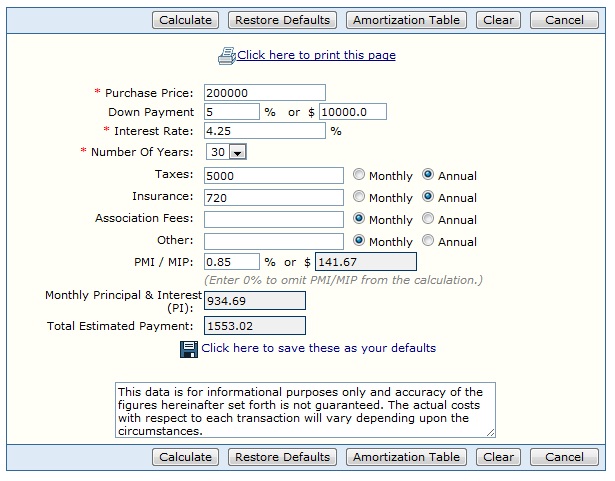
Check out the screenshot below; this is the blank slate. We'll start with the simplest calculation and then add the other moving parts.


Example #1: $200,000 purchase, 20% down payment. Property taxes of $5,000/yr, and homeowners insurance of $720/yr. Here we will only have principal & interest, property tax escrow, and homeowners insurance escrow. Enter the purchase price, $200,000. Enter the down payment as a percent (20%), and the $ field will auto-populate. Enter the interest rate: As of today I'm entering 4.25%, but the day will come when that will seem utterly outrageous. Leave the Number of Years at 30 unless you're pursuing a 15yr mortgage or other term. Enter the annual property taxes of $5,000. Enter the ANNUAL mortgage insurance of $720 and click the ANNUAL radio button, or if you're premium was quoted as a MONTHLY amount, enter that number and leave the MONTHLY radio button selected. Click Calculate, and voila:


The calculator separates out the principal & interest amount, then provides the total estimated payment including taxes and insurance. Toy around with the interest rate and the price to see how the payment changes - for instance, how much will a .25% increase in the interest rate change the payment? How much will the payment change if you get the house for $195,000 or $190,000 instead of $200,000?

Example #2: Same as Example #1, except now let's say you're getting a 5% down conventional mortgage. So you'll change the down payment to 5%, and you'll have to add mortgage insurance. (For more info on what mortgage insurance is and how it's figured out, read this article.) Today I'm using .85% for mortgage insurance, but this rate will vary depending on the borrower's credit score, amount of down payment, and market conditions. Enter .85% into the PMI / MIP field, which stands for "private mortgage insurance / mortgage insurance premium."


The calculator has also separated out the monthly mortgage insurance amount here. What a nice mortgage calculator.

Example #3: Now imagine the property in Example #2 is a condo with a monthly association fee of $150. Just enter $150 into the Association Fees field, make sure the MONTHLY radio button is selected, and the calculator will include this amount in the total estimated payment. I won't bore you with a screenshot of this one, you get the point.

Example #4: And for the grand finale, we will use an FHA loan. (For more information on what an FHA loan is and why it's different for this purpose, read this article.) Use the same information from Example #2, except change the down payment to 1.75%, and change the PMI rate to 1.25%. The minimum FHA down payment is actually 3.5%, however there is an upfront mortgage insurance premium for FHA loans (separate from what is paid monthly) that can be rolled into the loan as opposed to being paid at the closing. With interest rates so low, it's extremely common in today's market to roll the upfront MIP into the loan. The upfront MIP rate is currently 1.75% of the loan amount, so in order to account for adding that amount to the loan balance, we're taking it off the 3.5% down payment. Here's the result:


So you can see, when comparing Examples #1, #2, and #3, the difference in the affordability of the payment depending on the amount of your down payment and the type of financing you're using.

Hopefully this article allows you to figure out what you can afford when looking at a purchase or refinance. Of course, you'll still need me to set you up with an MLS account and a good loan officer to fill you in on the latest changes in interest rates, mortgage insurance rates, and financing programs available - but this is a start!

Sunday, March 4, 2012

New Down Payment Assistance Program in Park Forest, Chicago Heights

The Illinois Housing Development Authority (IHDA) is piloting a new housing assistance program called Illinois Building Blocks to help stabilize communities hit hard by the foreclosure crisis. The program has three parts:

1. Providing financing to local developers to purchase and rehab 10-15 homes to be resold to to low- and moderate-income families. In Park Forest this will be focused in the "W" and "M" streets. Starting this summer.
2. Providing a $10,000 gift as down-payment and closing cost assistance to home buyers earning less than $84,000/yr (for 1-2 person househould) to $104,000 (for households of 3+). Starting 3/1/12.
3. In conjunction witKeepYourHomeIllinois.org, providing foreclosure counseling, loan modifications, and financial assistance to homeowners unable to pay their mortgages due to unemployment or underemployment.

The communities involved in the pilot program are Park Forest, Chicago Heights, Riverdale, South Holland, Maywood, and Berwyn.

Monday, February 20, 2012

Common Questions Answered: Buying Short Sales & Foreclosures


Distressed property is all the rage these days. And it's a good thing: If it weren't for investors and bargain hunters snapping up low-priced inventory, we'd be in a whole different place (a much worse one).
When we speak of distressed property, we're primarily talking about short sales and foreclosures. In almost every initial conversation I have with any potential buyer, they inevitably ask me what the difference is between short sales and foreclosures. So I'll start there and pose a few of the most common questions I get, along with my answers. If you have a question I don't answer here, post it below and I'll get right on it.
Q: So what is the difference between a short sale and a foreclosure?
A: A foreclosure, also known as a bank-owned property or REO (real estate owned, which is how it shows up on the bank's books), is property the bank has repossessed from the owner due to nonpayment of the mortgage. The bank owns the property outright and hopes to sell it for as much as possible to recoup some of their losses on the deal.
A short sale is a situation in which, most likely, the owner has fallen behind on mortgage payments, the bank is moving to foreclose, and the amount owed on the mortgage is greater than the property's value (some call this condition "underwater"). The owner is trying to sell the property for whatever it's worth, hoping their lender would rather take a discounted or "short" payoff right now instead of seeing the rest of the lengthy foreclosure process through. So in this situation, the seller still owns the property, but their lender calls the shots.
Q: How long do these transactions take to close?
A: An offer on a foreclosure will usually get a response within five business days. After that, you can close within a normal time frame (30-45 days).
An offer on a short sale must be signed by the seller, then submitted to the seller's lender for review along with a litany of other documents. Depending on which lender holds the mortgage, how many mortgages and other liens there are, and the skill and experience level of the person handling the short sale (typically the seller's agent or attorney), buyers can expect a response to their offer within three to six months. That time frame is rarely shorter and occasionally longer.
Q: What additional risk is involved in buying distressed property?
A: Both short sales and foreclosures are sold "AS-IS." That means the seller is not going to do anything to the property and the buyer accepts it with whatever physical or legal defects it may have. Buyers CAN and always SHOULD have a home inspection done, and they can still back out of the deal if the inspection turns up anything unacceptable. The buyer is also responsible for passing any municipal inspections, purchasing all transfer stamps (even those customarily purchased by the seller), and ordering a survey if their lender requires one.
In the case of a short sale, the seller will provide the customary disclosures regarding the property's condition and any known material defects, as required by state law. A bank selling REO has likely never even seen the property; therefore it is exempt from those disclosures and buyers are truly on their own.
One thing that is NOT different about buying distressed property is that the seller (if it's REO) or the seller's lender (if it's a short sale) WILL provide the buyer with clean title and a title insurance policy, just like a traditional sale. That means they clear up any known liens on the property and pay or credit the buyer for any unpaid real estate taxes. You may open a can of worms fixing the place up, but at least you know it's yours!
Q: Should you include foreclosures and short sales in your home search?
A: It depends.
I almost always advise buyers to include foreclosures. They are frequently priced below-market and present great opportunities for instant equity. The only time we have to be careful with foreclosures is when a buyer only qualifies for FHA financing. When FHA appraises the property they expect everything to be intact and fully functional; they won't lend on it if anything is broken or missing (e.g. windows, a bath vanity or kitchen cabinets, a furnace). An ordinary seller might offer to get the property into "FHA condition," but if it's owned by a bank you can pretty much forget it. There are exceptions, but that's a whole other discussion.
I advise buyers to include short sales when their circumstances allow it. Due to the time frame they take to close, short sales are often a consideration for people who are not on a timeline: Those who don't have to sell and buy at the same time, investors purchasing multiple properties - in general, buyers who aren't in any sort of hurry. For buyers who need to close before their lease is up, live in a certain school district or area by a set date for school or work, or in general have to be moved by particular date, short sales are not recommended. Same goes for anyone who lacks patience!
Q: Which is a better deal, short sales or foreclosures?
A: Ah, the million dollar question. Where can you get the best deal? There are two schools of thought on this, but I believe foreclosures most frequently present the best opportunities. Why? Primarily because of the way the bank determines what price they'll take for a house when they already own it, which is different from how they evaluate it when the borrower still owns it.
With short sales, once an offer is received and submitted to the seller's lender, they hire an appraiser to give them the current, as-is market value of the property. They will usually accept a certain percentage of that value, commonly about 90%. If there are other liens on the property, such as a second mortgage or delinquent property taxes, those liens need to be satisfied too - after the lender who holds the first mortgage gets their 90%. So the best deal you're going to get is 90% of the property's current as-is value, as determined by an appraiser, but you might have to cough up a little more depending on secondary liens.
With foreclosures, the price is determined by an asset manager who bases his/her decision on a BPO - that's a broker opinion of value, a report completed by a real estate agent who is often going to be the one listing the property for sale. It's in the agent's best interests to get the bank to list the property for an attractive price. In fact, many banks request the BPO agent to recommend a "30-day sale price." So when these listings come on, they're often at hot prices.
A few years ago when short sales were just coming on the radar, banks used desktop valuations or BPOs for short sales instead of appraisals, and they didn't have the procedures and rules they have in place now. It's those appraisals, procedures and rules that have changed the game with short sales and made foreclosures more attractive in my experience.
I did a little research to back up my belief, for those who might disagree. I looked at the median sale prices of all foreclosed and short sale residential property that has sold in the past 12 months in Oak Lawn, Matteson, Tinley Park, and the Loop (as of October 2011). In every case, the median sale price of foreclosures was lower than the median sale price of short sales - by anywhere from 3% (in Matteson) to almost 30% (in Tinley Park). Further, in all three suburban areas, foreclosures sold for a larger discount off their asking prices than did short sales. That didn't hold up in the Loop where foreclosures sold for a median of almost 107% of their asking prices - but that was still 19% lower than the median short sale price.
So if you have any general or specific questions I didn't touch on here... Fire away!