Showing posts with label down payment. Show all posts

Thursday, November 14, 2013

Getting Your Offer Accepted

As Bob Dylan, said, “The times, they are changin’.” Not too long ago, advice on this topic wouldn’t have been necessary. Since the beginning of this year, however, one of the biggest challenges buyers have faced is wrapping their heads around the fact that they don’t call the shots anymore. Inventory is way down across the board, and for the first time in a long time there are more buyers than sellers. So landing a great deal takes a bit more effort than it has in recent years.

As a buyer, there are certain things you seek in a home. Your needs are unique, but the general characteristics that make a home appealing within a particular area or price range are almost universal amongst buyers. That means you’ve got competition. More and more, well-priced listings are attracting multiple offers within days after hitting the market, and they’re selling for sometimes far in excess of the seller’s asking price. Even without multiple offers on the table, sellers of well-priced listings know if any given offer isn’t all that attractive, they can simply wait for the next one which should be arriving shortly. The seller has their pick of buyers, and it’s up to you to convince them you’re the one!

What sellers are looking for is NOT just the highest possible price, though – they’re looking for the best possible price with the highest likelihood of closing. So what can you do to make your offer more attractive than others?

 Price. Although price isn’t the only concern, it’s still the primary one. Offer high enough, and the other considerations fade out as dollar signs enter the sellers’ eyes.
Financing. Plain and simple, cash is king. Sellers frequently accept lower cash offers because their likelihood of closing is much higher than that of a financed offer. If you don’t have enough cash available, consider such creative methods as 401(k) loans, private mortgages (i.e. to a family member), or for investors, hard money. If you must finance, then use the strongest financing you can qualify for. In order, that would be:
a.       Conventional with 20% or more down
b.      Conventional with less than 20% down
c.       FHA with 10% or more down
d.      FHA with less than 10% down
e.       Rehab loan, such as FHA 203(k)
           Time. Typically, sellers list their homes when they’re ready to sell them. (Duh, right?) So the faster you can close, the faster they can move on with their lives. If you’re buying cash, you can probably close within two weeks. With conventional financing you can shoot for 30 days, and with FHA you’re looking at 30-45. Rehab loans take a minimum of 60 days and can easily drag on for much longer.
      Contingencies. The fewer contingencies, the better. Attorney review and inspection contingencies are built into the contract, but that doesn’t mean they can’t be waived/eliminated. If you must finance the purchase, then you must include a financing contingency – there’s no way around that. A sale of home contingency (you have to sell your house in order to buy the next one) significantly weakens your offer by extending the time frame and introducing a large amount of uncertainty. If you’re competing with other offers and you are contingent-on-sale, you’re very unlikely to win.
       Incentives. Additional personal property, closing cost credits, seller-paid points, home warranties, high tax prorations, pre-closing possession… These are just some of the “perks” buyers can, and frequently have, requested when making offers over the last few years. On top of nickel-and-diming the sellers with these items, they complicate the presentation of the offer. Author Les Brown said, “Shoot for moon. Even if you miss, you’ll land among the stars.” Sorry Les, but in this market if you shoot for the moon as a buyer you’ll likely just end up by yourself in outer space. Keep the perks to a minimum if you want the best price, or to get the house at all.
      Heart strings. Most sellers are human beings, and most human beings have emotions. In some instances, it can work in your favor to submit a “personal letter” to the seller to demonstrate why you love their home and how you’ll take great care of it for many years. When to include a personal letter is a topic for another day!

Here’s the rule of negotiations, of which I’m sure Yogi Berra would approve: Everything other than price costs money. Handing a briefcase full of cash to the seller on the spot is the surest, fastest way to complete the sale, and if you could do that, you would get the house for the absolute lowest price possible (although it’s probably not a great idea for other reasons). Anything beyond that – each extra step, each contingency, each week that must pass before closing, each nugget of uncertainty – must be accompanied by a higher price to compensate the seller for the additional risk. On the opposite end of the spectrum from the briefcase-full-of-cash buyer is the buyer who makes an offer contingent-on-sale, financed with a 203(k) rehab loan, a 90-day closing, and throw in the 1976 Eldorado that’s in the garage. This buyer would have to pay dearly in order for their offer to even be considered.


Keep these considerations in mind when you’re thinking about how to structure an offer. Better yet, hire an agent who can advise you as to how much you can ask for on any given listing while still getting a house you’ll love for the best possible price.

Friday, April 27, 2012

How to use the MLS mortgage calculator

When considering buying or refinancing a home, affordability is often the most important factor - not the amount financed, but the amount of the payment. The concept of $300,000 isn't something we can easily grasp in everyday terms, but the payment we make every month is immediately applicable to our lives. I often quote estimated payments to home buyers to help them evaluate their decisions, because figuring a mortgage payment isn't exactly simple math. But better than giving you a fish is teaching you to fish, so here's a step-by-step guide on how to calculate estimated mortgage payments using the MLS mortgage calculator.

Depending on whether you're talking about a house or a condo/townhouse, and depending on what type of financing you're using, there are going to be three to five different parts of the payment. The first part is the principal and interest, which is the mortgage itself and is calculated just like a big, long, car note. You'll also be escrowing your property taxes and homeowners insurance, which means you pay your mortgage company 1/12 of the annual cost of each of those expenses every month, they hold it in a separate account (escrow), and when the bills come due the mortgage company pays them. If you're putting less than 20% down, you'll also be paying mortgage insurance. And if the property is part of an association with a monthly fee, such as a condo or townhouse association, you'll also have to figure in the monthly association fee. Although this fee is paid directly to the association, not to your mortgage company, mortgage companies include it as a part of the payment for qualification purposes and you should include it when determining how much you can afford.

Check out the screenshot below; this is the blank slate. We'll start with the simplest calculation and then add the other moving parts.


Example #1: $200,000 purchase, 20% down payment. Property taxes of $5,000/yr, and homeowners insurance of $720/yr. Here we will only have principal & interest, property tax escrow, and homeowners insurance escrow. Enter the purchase price, $200,000. Enter the down payment as a percent (20%), and the $ field will auto-populate. Enter the interest rate: As of today I'm entering 4.25%, but the day will come when that will seem utterly outrageous. Leave the Number of Years at 30 unless you're pursuing a 15yr mortgage or other term. Enter the annual property taxes of $5,000. Enter the ANNUAL mortgage insurance of $720 and click the ANNUAL radio button, or if you're premium was quoted as a MONTHLY amount, enter that number and leave the MONTHLY radio button selected. Click Calculate, and voila:


The calculator separates out the principal & interest amount, then provides the total estimated payment including taxes and insurance. Toy around with the interest rate and the price to see how the payment changes - for instance, how much will a .25% increase in the interest rate change the payment? How much will the payment change if you get the house for $195,000 or $190,000 instead of $200,000?

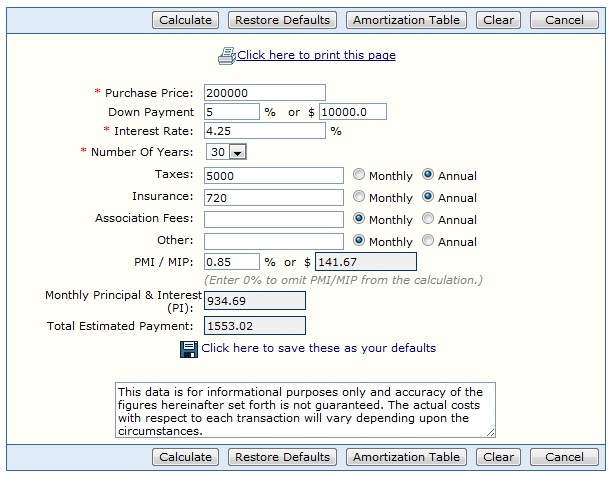
Example #2: Same as Example #1, except now let's say you're getting a 5% down conventional mortgage. So you'll change the down payment to 5%, and you'll have to add mortgage insurance. (For more info on what mortgage insurance is and how it's figured out, read this article.) Today I'm using .85% for mortgage insurance, but this rate will vary depending on the borrower's credit score, amount of down payment, and market conditions. Enter .85% into the PMI / MIP field, which stands for "private mortgage insurance / mortgage insurance premium."


The calculator has also separated out the monthly mortgage insurance amount here. What a nice mortgage calculator.

Example #3: Now imagine the property in Example #2 is a condo with a monthly association fee of $150. Just enter $150 into the Association Fees field, make sure the MONTHLY radio button is selected, and the calculator will include this amount in the total estimated payment. I won't bore you with a screenshot of this one, you get the point.

Example #4: And for the grand finale, we will use an FHA loan. (For more information on what an FHA loan is and why it's different for this purpose, read this article.) Use the same information from Example #2, except change the down payment to 1.75%, and change the PMI rate to 1.25%. The minimum FHA down payment is actually 3.5%, however there is an upfront mortgage insurance premium for FHA loans (separate from what is paid monthly) that can be rolled into the loan as opposed to being paid at the closing. With interest rates so low, it's extremely common in today's market to roll the upfront MIP into the loan. The upfront MIP rate is currently 1.75% of the loan amount, so in order to account for adding that amount to the loan balance, we're taking it off the 3.5% down payment. Here's the result:


So you can see, when comparing Examples #1, #2, and #3, the difference in the affordability of the payment depending on the amount of your down payment and the type of financing you're using.

Hopefully this article allows you to figure out what you can afford when looking at a purchase or refinance. Of course, you'll still need me to set you up with an MLS account and a good loan officer to fill you in on the latest changes in interest rates, mortgage insurance rates, and financing programs available - but this is a start!