There are certain everyday terms that never killed anyone but have become expletives in the wake of the financial collapse. Included are ARMs (adjustable rate mortgages), sub-prime, credit default swaps, and, probably to a lesser extent, reverse mortgages. "Reverse mortgage" sounds like an easy way for something bad to happen to your house. But despite the bad name, they can actually be a very wise financial decision - of course, depending on the circumstances of the borrower in question.
A reverse mortgage is an FHA-insured loan, officially called a Home Equity Conversion Mortgage (HECM). (And yes, it is pronounced, "heckem.") The basics are here, but as usual, I'm going to be a nice guy and tell you what you really need to know, right here.
When you buy a home with a typical mortgage (referred to in this context as a "forward" mortgage), you put down a certain amount of money - let's say 10% - and finance the rest over some time, usually 30 years. You have a monthly payment that includes principal, interest, mortgage insurance, property taxes, and homeowners insurance. You pay on that loan until it's paid off, or more likely until you refinance, sell the house, or die. After all, the term "mortgage" is a blend of the Latin roots "mort" (dead) and "gage" (pledge).
The first manner in which I will blow your mind is to tell you that you can actually BUY a house using a reverse mortgage. I admit, I did not know this myself until just recently. I thought reverse mortgages were for very old people who owned their house outright and wanted or needed to access the equity. And although that is still part of the picture, since I'm a real estate broker I am fixating on the ability to purchase a home using a reverse mortgage.
A reverse mortgage works the opposite way from a forward mortgage (but you knew that). Simply put, the borrower makes a down payment - larger than what most people are putting down these days on forward mortgages - closes on the house, and does not make any mortgage payments whatsoever for the remainder of the time they live in the house. The benefit here is pretty obvious - the borrower doesn't have to make a mortgage payment, ever. At this point many readers will think, "But the mortgage balance grows because they're not making payments!" It's true. The interest that normally would be paid monthly instead accrues and is capitalized (added to the principal balance of the loan). On a $200,000 loan, at 4.5% interest, that's $750/mo. Today's reverse mortgage interest rates are slightly higher (and also unrelated, tied to different indices, and much more stable) than forward mortgage rates, clocking in at 4.00-4.50%. So the fear is that the mortgage balance grows too much, too fast, creating a negative equity or "underwater" situation, right?
Time for an example to illustrate why that's less of a problem than you might think, which will result in a second blowing of your mind. Let's say Bertha is a 70-year old widow, living on a fixed income consisting only of social security. Bertha, like most human beings, likes to eat good food, spend time with the family, maybe go somewhere warm every now and then. And of course she has regular bills to pay, like insurance, prescriptions, cable, that good old land line, and her riverboat allowance. Well, with increasing cost of living, Bertha ain't doing so well anymore - the grandkids are getting $5 bills for their birthdays as opposed to the customary $10, and the penny slots are the only thing at the casino seeing any action.
(I'm still working on blowing your mind again, this point just takes awhile to develop. Hang in there.)
So let's say Bertha buys a house. Why, you ask? Well, Bertha had to get double knee replacement surgery, and her tri-level home won't cut it anymore, so she has to get a ranch. So anyways, let's say Bertha buys a house. Let's say Bertha buys a house for $300,000. Let's say Bertha buys a house for $300,000 and puts $100,000 down. So here's Bertha with a $200,000 mortgage to pay, on top of all the aforementioned expenditures. She's coughing up $900/mo for principal and interest (assuming 3.5% interest), not even counting property taxes or homeowners insurance. Not looking real good for Bertha, or the casino, or the birthday cards.
Alternatively, let's say Bertha buys a house for $300,000, puts $100,000 down, and gets a reverse mortgage. She still owes $200,000, but she has no mortgage payment. As she's told you a thousand times by now, she's 70 years old and she's earned it, so why shouldn't she be able to enjoy it? Her mortgage interest is capitalized at a rate of $750/mo (assuming 4.5% interest), and she lives out the autumn of her years, giving out full $10 birthday cards and playing only the newest of the new slot machines, until she fulfills her life expectancy of 81. At that time, her mortgage balance has grown by $126,500 (4.5% annual interest and 1.25% annual FHA mortgage insurance for 11 years). During the same 11-year period, with a traditional mortgage she would have made principal and interest payments totaling over $118,000. So in the end, it cost her a few thousand more. But the difference is the $118,000 Bertha did NOT spend on mortgage payments while she was still here, that was instead spent on enjoying what she's worked her whole life to enjoy.
And here's where I arrive at the mind-blow: By this point, the house might be worth $400,000. The family/estate inherits the house, sells it for $400,000, pays off the $326,500 mortgage, and keeps the proceeds. Just to be clear: If there is equity, nobody steals it. It belongs to the owner, and/or their estate. Sure, it may not be much, definitely not as much as if she'd have gotten a forward mortgage, but what would any decent son or daughter want - more money for themselves upon their mother's death, or more money for her during her life?
Final mind-blow: If this story happened to take place in a declining real estate market - I mean, purely hypothetically speaking, because we've never seen anything like that - and the home's value fell from $300,000 to $200,000 while the mortgage grows to $326,500... Assuming the family/estate doesn't want the house, the bank takes title to the property, appraises it and sells it, FHA chunks in the negative equity ($126,500) to cover the difference, and the family/estate is off the hook. That's the beauty: Reverse mortgages are non-recourse loans. They are secured ONLY against the subject real estate, without the ability to pursue any other income or assets, and they're insured by FHA to account for the risk that the principal balance accrues faster than the home's value.
It's definitely not a product for everyone, but in certain situations a reverse mortgage could be a real quality-of-life-saver. Some of the less interesting but nevertheless pertinent facts are:
- Only senior citizens (age 62 or older) can obtain a reverse mortgage. Most people who get one are 70 or older.
- Required down payment amounts vary with age - the younger you are, you more you have to put down - but will not be lower than 15% or higher than 50%.
- Just like with forward FHA loans, there is an upfront mortgage insurance premium charged at the closing in addition to the monthly/annual mortgage insurance premium. For reverse mortgages, the upfront MIP is 2% of the loan amount and can be financed into the loan.
- There are currently no credit or income requirements, although some will go into effect this fall. They will be much looser requirements than what is expected in order to obtain a forward mortgage, so seniors on fixed incomes who might have difficulty qualifying for a forward mortgage can still obtain a reverse mortgage much more easily.
- There are other reverse mortgage programs available, outside of the fixed "Standard/Saver" program I've outlined here, which involve lines of credit, benefits from an increasing interest rate environment, etc.
In the end, the benefit is that your family member or loved one may be able to live the last years of their life more happily, or use a reverse mortgage to buy into a supportive, adult community that may not otherwise be affordable for them. And for an elderly person with no children (or only worthless, irresponsible children to whom they would never leave their estate), a reverse mortgage is a no-brainer.
Back to that question about reverse mortgages and idiots, though... Nope. They can be a great decision and in many instances are recommended by financial advisors and estate planners. If it sounds like a consideration for anyone in your family, let me know and I can put you in touch with someone who specializes in these.
Showing posts with label mortgage insurance. Show all posts
Showing posts with label mortgage insurance. Show all posts
Friday, June 7, 2013

Friday, April 27, 2012
FHA Financing and HUD Foreclosures
First off, HUD is the U.S. Department of Housing and UrbanDevelopment. FHA is the Federal Housing Administration,
an agency administered by HUD. For our purposes, they are one and the same.
An FHA mortgage is a mortgage made by any lender for which
FHA is the mortgage insurance company (for more info on mortgage insurance, see this article). There are
three types of FHA mortgages. All are available only to owner occupants, not
investors.
203(b): This is the standard FHA loan. Borrowers may qualify
with credit scores as low as 580, debt ratios as high as 56%, and down payments
as low as 3.5%. The property can be any house, townhouse, 1-4 unit multifamily
building, or FHA-approved condominium (more on this later). The property must
also be in 100% livable condition with all systems functioning properly, no safety hazards, no mold, etc. It can be ugly as sin, as long as it works.
203(k): This is the "rehab mortgage" version of
FHA financing. It allows the buyer to finance the purchase and rehab costs of a
home. Rehab costs must exceed $5,000. Example: A house is currently worth
$50,000 and is in need of extensive repairs. After those repairs it will be
worth $150,000. The buyer makes a down payment and purchases the house for
$50,000. The buyer's mortgage is $125,000, with the difference being
held in an escrow account. As the repairs are made by licensed contractors who
bid the project out before the closing, the contractors are paid out of the
escrow account. Work is completed, the borrower moves in with a mortgage of
$125,000, and the house is worth $150,000. The 203(k) loan is good because it
allows for a great deal of flexibility, but it is a long and complicated
process relative to a 203(b) and many lenders don't offer it. More info here and here.
203(k) Streamline: This is what it sounds like - a quicker,
easier version of the 203(k) rehab loan. The buyer can finance rehab costs up to
$35,000 into the loan, but money cannot be used for structural work. For more
info, click here, then click on the "HUD Mortgagee Letter" link.
FHA-approved condominiums: Aside from any restrictions
mentioned above, any type of FHA financing can only be used on a condo if the
condo project (development, building, complex, whatever you want to call it)
has been approved for FHA financing. The condo association needs to gather all
of their legal and financial documents and submit an application to FHA, who
will then review the file and determine if the association meets their
criteria. These criteria include a minimum amount of cash held in reserve,
maximum concentration of FHA loans in the complex, maximum number of rented
units, and maximum number of units delinquent on assessments, among others.
Once the project is FHA approved, buyers can use FHA financing to purchase
there. Beware - many homes that appear to be townhomes are legally condos,
which must be approved. Most people don't know there's a very easy way to verify whether an association is FHA-approved: the HUD database.
HUD REO: You already know what HUD is. REO stands for
"real estate owned," and that's how banks refer to their foreclosed
inventory. HUD REO refers to property that was mortgaged with an FHA loan that
foreclosed; the property is now owned by HUD. HUD allows some extra leeway in
financing their REO, and they provide more information than any other bank or
seller pertaining to the property's value and condition.
Run a search in your state and ZIP code on HUD's REO website. Click on the property case number for one of
the listings to pull up the details. Photos are shown at the far left; basic
property attributes are shown in the middle; and on the right you will see some
listing dates and deadlines and then the "As-is Value." HUD already
had the property appraised in its current condition, and this number is the
appraised value as of the "Appraisal Date" shown in the middle
column.
Below the as-is value, you'll see "FHA Financing:"
followed by one of three codes.
> IN (Insured): Property condition meets FHA 203(b)
standards.
> IE (Insured Escrow): Property condition ALMOST meets
203(b) standards. Repairs of $5,000 or less are needed. Buyer can use 203(b) by
posting a repair escrow (see below).
> UI (Uninsured): Property needs more than $5,000 of
repairs to comply with 203(b) standards and is therefore not eligible for
203(b). Buyer must use 203(k) or Streamline if eligible (see below).
The next line down shows if the property is eligible for
203(k) loans. This almost always says "Yes," but it will say
"No" if the property is a condo in a complex that is not currently
FHA approved.
Keep moving down and you'll see the line "Repair
Escrow" followed by an amount (if the status was IE). If the buyer wishes
to use a 203(b) loan, they must post this amount into an escrow account at the
closing, have the necessary repairs done to bring the property into compliance,
and complete a compliance review before the escrowed funds are released back to
them.
Below the repair escrow amount, you will see "Review
PCR for Repair Escrow Items." Click on the "Addendums" tab. You
will see a few links; the one you want is the PCR or Property Condition Report.
Click the link and download the PDF. A HUD contractor tested various components in
the property, including all the major mechanicals, and this report shows the
results. Another file on this same page, usually titled Escrow report or PCR summary, shows the contractor's estimate of the repair costs and the total amount that must be escrowed.
In the Addendums tab you may also see a link for HUD's
"$100 down payment" program. This means a buyer purchasing this
property with any type of FHA financing can qualify for a $100 down payment
instead of the usual 3.5%, during special promotional periods.
How cool is that? They tell you the appraised value, what's
wrong with the property, and how much it will cost to fix. Find me another
institutional seller (or any seller, for that matter) who will do that!
Bidding on HUD property is a different conversation, but
unlike some bidding sites an offer can only be input by a HUD-registered
broker. If you’re reading this article then you know a HUD registered broker,
so check the website out, then talk to me!
How to use the MLS mortgage calculator
When considering buying or refinancing a home, affordability is often the most important factor - not the amount financed, but the amount of the payment. The concept of $300,000 isn't something we can easily grasp in everyday terms, but the payment we make every month is immediately applicable to our lives. I often quote estimated payments to home buyers to help them evaluate their decisions, because figuring a mortgage payment isn't exactly simple math. But better than giving you a fish is teaching you to fish, so here's a step-by-step guide on how to calculate estimated mortgage payments using the MLS mortgage calculator.
Depending on whether you're talking about a house or a condo/townhouse, and depending on what type of financing you're using, there are going to be three to five different parts of the payment. The first part is the principal and interest, which is the mortgage itself and is calculated just like a big, long, car note. You'll also be escrowing your property taxes and homeowners insurance, which means you pay your mortgage company 1/12 of the annual cost of each of those expenses every month, they hold it in a separate account (escrow), and when the bills come due the mortgage company pays them. If you're putting less than 20% down, you'll also be paying mortgage insurance. And if the property is part of an association with a monthly fee, such as a condo or townhouse association, you'll also have to figure in the monthly association fee. Although this fee is paid directly to the association, not to your mortgage company, mortgage companies include it as a part of the payment for qualification purposes and you should include it when determining how much you can afford.
Check out the screenshot below; this is the blank slate. We'll start with the simplest calculation and then add the other moving parts.

Example #1: $200,000 purchase, 20% down payment. Property taxes of $5,000/yr, and homeowners insurance of $720/yr. Here we will only have principal & interest, property tax escrow, and homeowners insurance escrow. Enter the purchase price, $200,000. Enter the down payment as a percent (20%), and the $ field will auto-populate. Enter the interest rate: As of today I'm entering 4.25%, but the day will come when that will seem utterly outrageous. Leave the Number of Years at 30 unless you're pursuing a 15yr mortgage or other term. Enter the annual property taxes of $5,000. Enter the ANNUAL mortgage insurance of $720 and click the ANNUAL radio button, or if you're premium was quoted as a MONTHLY amount, enter that number and leave the MONTHLY radio button selected. Click Calculate, and voila:

The calculator separates out the principal & interest amount, then provides the total estimated payment including taxes and insurance. Toy around with the interest rate and the price to see how the payment changes - for instance, how much will a .25% increase in the interest rate change the payment? How much will the payment change if you get the house for $195,000 or $190,000 instead of $200,000?
Example #2: Same as Example #1, except now let's say you're getting a 5% down conventional mortgage. So you'll change the down payment to 5%, and you'll have to add mortgage insurance. (For more info on what mortgage insurance is and how it's figured out, read this article.) Today I'm using .85% for mortgage insurance, but this rate will vary depending on the borrower's credit score, amount of down payment, and market conditions. Enter .85% into the PMI / MIP field, which stands for "private mortgage insurance / mortgage insurance premium."

The calculator has also separated out the monthly mortgage insurance amount here. What a nice mortgage calculator.
Example #3: Now imagine the property in Example #2 is a condo with a monthly association fee of $150. Just enter $150 into the Association Fees field, make sure the MONTHLY radio button is selected, and the calculator will include this amount in the total estimated payment. I won't bore you with a screenshot of this one, you get the point.
Example #4: And for the grand finale, we will use an FHA loan. (For more information on what an FHA loan is and why it's different for this purpose, read this article.) Use the same information from Example #2, except change the down payment to 1.75%, and change the PMI rate to 1.25%. The minimum FHA down payment is actually 3.5%, however there is an upfront mortgage insurance premium for FHA loans (separate from what is paid monthly) that can be rolled into the loan as opposed to being paid at the closing. With interest rates so low, it's extremely common in today's market to roll the upfront MIP into the loan. The upfront MIP rate is currently 1.75% of the loan amount, so in order to account for adding that amount to the loan balance, we're taking it off the 3.5% down payment. Here's the result:

So you can see, when comparing Examples #1, #2, and #3, the difference in the affordability of the payment depending on the amount of your down payment and the type of financing you're using.
Hopefully this article allows you to figure out what you can afford when looking at a purchase or refinance. Of course, you'll still need me to set you up with an MLS account and a good loan officer to fill you in on the latest changes in interest rates, mortgage insurance rates, and financing programs available - but this is a start!
Depending on whether you're talking about a house or a condo/townhouse, and depending on what type of financing you're using, there are going to be three to five different parts of the payment. The first part is the principal and interest, which is the mortgage itself and is calculated just like a big, long, car note. You'll also be escrowing your property taxes and homeowners insurance, which means you pay your mortgage company 1/12 of the annual cost of each of those expenses every month, they hold it in a separate account (escrow), and when the bills come due the mortgage company pays them. If you're putting less than 20% down, you'll also be paying mortgage insurance. And if the property is part of an association with a monthly fee, such as a condo or townhouse association, you'll also have to figure in the monthly association fee. Although this fee is paid directly to the association, not to your mortgage company, mortgage companies include it as a part of the payment for qualification purposes and you should include it when determining how much you can afford.
Check out the screenshot below; this is the blank slate. We'll start with the simplest calculation and then add the other moving parts.

Example #1: $200,000 purchase, 20% down payment. Property taxes of $5,000/yr, and homeowners insurance of $720/yr. Here we will only have principal & interest, property tax escrow, and homeowners insurance escrow. Enter the purchase price, $200,000. Enter the down payment as a percent (20%), and the $ field will auto-populate. Enter the interest rate: As of today I'm entering 4.25%, but the day will come when that will seem utterly outrageous. Leave the Number of Years at 30 unless you're pursuing a 15yr mortgage or other term. Enter the annual property taxes of $5,000. Enter the ANNUAL mortgage insurance of $720 and click the ANNUAL radio button, or if you're premium was quoted as a MONTHLY amount, enter that number and leave the MONTHLY radio button selected. Click Calculate, and voila:

The calculator separates out the principal & interest amount, then provides the total estimated payment including taxes and insurance. Toy around with the interest rate and the price to see how the payment changes - for instance, how much will a .25% increase in the interest rate change the payment? How much will the payment change if you get the house for $195,000 or $190,000 instead of $200,000?
Example #2: Same as Example #1, except now let's say you're getting a 5% down conventional mortgage. So you'll change the down payment to 5%, and you'll have to add mortgage insurance. (For more info on what mortgage insurance is and how it's figured out, read this article.) Today I'm using .85% for mortgage insurance, but this rate will vary depending on the borrower's credit score, amount of down payment, and market conditions. Enter .85% into the PMI / MIP field, which stands for "private mortgage insurance / mortgage insurance premium."
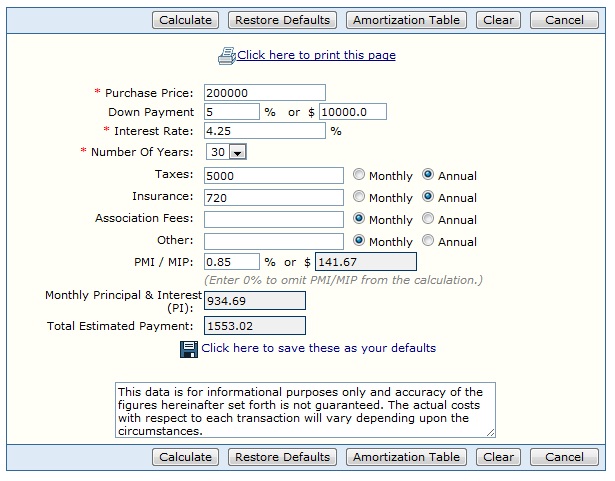
The calculator has also separated out the monthly mortgage insurance amount here. What a nice mortgage calculator.
Example #3: Now imagine the property in Example #2 is a condo with a monthly association fee of $150. Just enter $150 into the Association Fees field, make sure the MONTHLY radio button is selected, and the calculator will include this amount in the total estimated payment. I won't bore you with a screenshot of this one, you get the point.
Example #4: And for the grand finale, we will use an FHA loan. (For more information on what an FHA loan is and why it's different for this purpose, read this article.) Use the same information from Example #2, except change the down payment to 1.75%, and change the PMI rate to 1.25%. The minimum FHA down payment is actually 3.5%, however there is an upfront mortgage insurance premium for FHA loans (separate from what is paid monthly) that can be rolled into the loan as opposed to being paid at the closing. With interest rates so low, it's extremely common in today's market to roll the upfront MIP into the loan. The upfront MIP rate is currently 1.75% of the loan amount, so in order to account for adding that amount to the loan balance, we're taking it off the 3.5% down payment. Here's the result:

So you can see, when comparing Examples #1, #2, and #3, the difference in the affordability of the payment depending on the amount of your down payment and the type of financing you're using.
Hopefully this article allows you to figure out what you can afford when looking at a purchase or refinance. Of course, you'll still need me to set you up with an MLS account and a good loan officer to fill you in on the latest changes in interest rates, mortgage insurance rates, and financing programs available - but this is a start!
Monday, February 20, 2012
So what the heck IS mortgage insurance anyway??
Mortgage insurance, or what you may have heard referred to as "PMI," is not to be confused with homeowners insurance (which is also known as hazard insurance, property insurance, etc.).
Mortgage insurance is an insurance policy that benefits mortgage lenders in the event they have to incur the costs of foreclosing on a property. Lenders require this insurance if the borrower is putting less than 20% down, due to the lender's increased risk in making such a loan. The borrower pays the premium on a monthly basis as a part of their mortgage payment, and the mortgage insurance premium is sent to a mortgage insurance company. If the borrower defaults and the lender has to foreclose, the mortgage insurance company kicks back a portion of the loan amount to the lender.
How much is that premium? It depends on many variables such as property type, credit score, location, current market conditions, etc. But for conventional loans, the range is from about .8% to 1.25%. Example: Take the initial loan amount, let's say $100,000. Multiply it by the rate, for instance .85%, and you get the annual mortgage insurance premium, in this case $850. Divide that by 12 and that's the monthly premium (about $71/mo in this example).
The Federal Housing Administration is essentially a public mortgage insurance company. So when you hear about an "FHA loan," that means the mortgage insurer is FHA. For an FHA loan with a minimum down payment of 3.5%, the annual mortgage insurance rate is 1.15% - higher than MI rates for conventional loans. Additionally, there is an upfront premium due at the closing in the amount of 1% of the loan amount. The upfront MI can either be paid at closing or rolled into the loan. Why pay more for MI by choosing an FHA loan? Because they offer better interest rates and less stringent credit and income requirements than conventional loans, and if you have a non-traditional job/career you're more likely to qualify for FHA.
In some cases, a borrower may qualify to buy out MI (on conventional loans only) by paying a fee at the closing. If the borrower's credit score is high enough (at least 700) and their debt ratio is low enough (45% or lower), they might be able to pay a fee of 1-2% of the loan amount in lieu of paying a monthly MI premium. Using the same numbers in the above example, this would be an upfront fee of $2,000 that would allow the borrower to get out of the $71 monthly premium. In this example, the borrower saves money if they keep the loan for more than 28 months.
Another way to avoid mortgage insurance is to get one mortgage for 80% of the purchase price and a second mortgage for 10% or 15% of the price, which still allows the borrower to put only 5-10% down. This strategy was used, abused, and squeezed to the last drop during the credit bubble, and it is much less common today because of the problems it caused. The problems came about because the second mortgage is always either an adjustable rate mortgage or a variable line of credit with a balloon date - aka "ticking time bomb." [You may have heard of an "80/20" - that's a first mortgage for 80% of the price and a second mortgage for 20%, with no down payment from the borrower. These were all the rage in 2005, then the rates on the second mortgages adjusted 3-5yrs later, payments skyrocketed and homeowners tried to sell. But they owed more than their house was worth because housing prices had already peaked. Enter housing meltdown.]
There is at least one loan program out there that allow borrowers to put down less than 20% but not pay MI. It is called HomePath Mortgage - special financing offered by Fannie Mae only on their foreclosures - and it comes with a minimum 3% down for owner occupants or 10% down for investors, both with no mortgage insurance.
Even if you can't avoid MI, not all is lost. The Homeowners Protection Act of 1998 laid down federal laws that require the cancellation of MI after certain conditions are met. A borrower can request MI cancellation after the loan balance reaches 80% of the initial purchase price, but the lender doesn't have to grant it. However, once the loan balance reaches 78% of the initial purchase price the lender must automatically cancel the MI. Of course there are exceptions - for more detailed info on those, check out this article on the FTC website.
And lastly, the MI premiums you pay may be tax deductible due to the Tax Relief and Health Care Act of 2006. That law created a tax deduction for MI premiums on policies issued on or after 1/1/2007 and was extended for policies issued through the end of 2011. Of course, again, there are exceptions summarized in an article on Bankrate.com, but you should speak with a tax professional to get specifics.
Mortgage insurance isn't looked upon favorably by the public, but it's a necessary evil and I'm glad it's here. Otherwise, every buyer in the nation would need 20% down and the housing market would be infinitely worse off. I'll leave you with a heartwarming, redeeming feature of mortgage insurance companies: MI companies have an interest in preventing foreclosures, because foreclosures mean they have to cough up cash to lenders. So if you ever get behind on your mortgage payment, call the MI company directly and see what they can do.
Subscribe to:
Posts (Atom)