Showing posts with label Property taxes. Show all posts

Friday, April 27, 2012

How to use the MLS mortgage calculator

When considering buying or refinancing a home, affordability is often the most important factor - not the amount financed, but the amount of the payment. The concept of $300,000 isn't something we can easily grasp in everyday terms, but the payment we make every month is immediately applicable to our lives. I often quote estimated payments to home buyers to help them evaluate their decisions, because figuring a mortgage payment isn't exactly simple math. But better than giving you a fish is teaching you to fish, so here's a step-by-step guide on how to calculate estimated mortgage payments using the MLS mortgage calculator.

Depending on whether you're talking about a house or a condo/townhouse, and depending on what type of financing you're using, there are going to be three to five different parts of the payment. The first part is the principal and interest, which is the mortgage itself and is calculated just like a big, long, car note. You'll also be escrowing your property taxes and homeowners insurance, which means you pay your mortgage company 1/12 of the annual cost of each of those expenses every month, they hold it in a separate account (escrow), and when the bills come due the mortgage company pays them. If you're putting less than 20% down, you'll also be paying mortgage insurance. And if the property is part of an association with a monthly fee, such as a condo or townhouse association, you'll also have to figure in the monthly association fee. Although this fee is paid directly to the association, not to your mortgage company, mortgage companies include it as a part of the payment for qualification purposes and you should include it when determining how much you can afford.

Check out the screenshot below; this is the blank slate. We'll start with the simplest calculation and then add the other moving parts.


Example #1: $200,000 purchase, 20% down payment. Property taxes of $5,000/yr, and homeowners insurance of $720/yr. Here we will only have principal & interest, property tax escrow, and homeowners insurance escrow. Enter the purchase price, $200,000. Enter the down payment as a percent (20%), and the $ field will auto-populate. Enter the interest rate: As of today I'm entering 4.25%, but the day will come when that will seem utterly outrageous. Leave the Number of Years at 30 unless you're pursuing a 15yr mortgage or other term. Enter the annual property taxes of $5,000. Enter the ANNUAL mortgage insurance of $720 and click the ANNUAL radio button, or if you're premium was quoted as a MONTHLY amount, enter that number and leave the MONTHLY radio button selected. Click Calculate, and voila:


The calculator separates out the principal & interest amount, then provides the total estimated payment including taxes and insurance. Toy around with the interest rate and the price to see how the payment changes - for instance, how much will a .25% increase in the interest rate change the payment? How much will the payment change if you get the house for $195,000 or $190,000 instead of $200,000?

Example #2: Same as Example #1, except now let's say you're getting a 5% down conventional mortgage. So you'll change the down payment to 5%, and you'll have to add mortgage insurance. (For more info on what mortgage insurance is and how it's figured out, read this article.) Today I'm using .85% for mortgage insurance, but this rate will vary depending on the borrower's credit score, amount of down payment, and market conditions. Enter .85% into the PMI / MIP field, which stands for "private mortgage insurance / mortgage insurance premium."
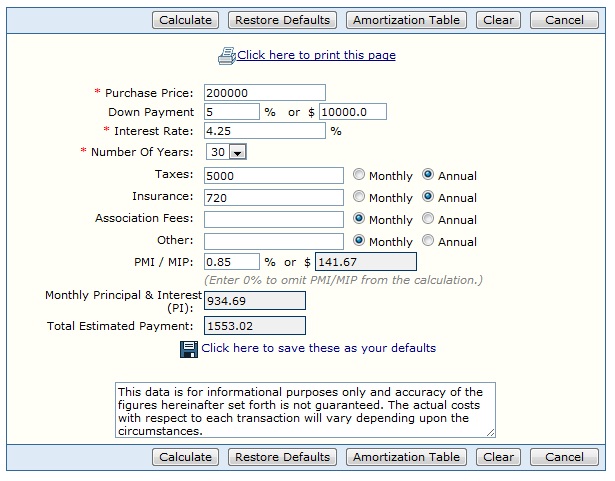

The calculator has also separated out the monthly mortgage insurance amount here. What a nice mortgage calculator.

Example #3: Now imagine the property in Example #2 is a condo with a monthly association fee of $150. Just enter $150 into the Association Fees field, make sure the MONTHLY radio button is selected, and the calculator will include this amount in the total estimated payment. I won't bore you with a screenshot of this one, you get the point.

Example #4: And for the grand finale, we will use an FHA loan. (For more information on what an FHA loan is and why it's different for this purpose, read this article.) Use the same information from Example #2, except change the down payment to 1.75%, and change the PMI rate to 1.25%. The minimum FHA down payment is actually 3.5%, however there is an upfront mortgage insurance premium for FHA loans (separate from what is paid monthly) that can be rolled into the loan as opposed to being paid at the closing. With interest rates so low, it's extremely common in today's market to roll the upfront MIP into the loan. The upfront MIP rate is currently 1.75% of the loan amount, so in order to account for adding that amount to the loan balance, we're taking it off the 3.5% down payment. Here's the result:


So you can see, when comparing Examples #1, #2, and #3, the difference in the affordability of the payment depending on the amount of your down payment and the type of financing you're using.

Hopefully this article allows you to figure out what you can afford when looking at a purchase or refinance. Of course, you'll still need me to set you up with an MLS account and a good loan officer to fill you in on the latest changes in interest rates, mortgage insurance rates, and financing programs available - but this is a start!

Tuesday, February 21, 2012

How Is My Property Tax Bill Calcuated?


Property taxes in Illinois, besides being levied at exorbitant rates compared to most other states, are dizzyingly complicated. It's even worse for homeowners in the most populous county in the state, Cook County. I've always said the Illinois property tax system could be sufficiently explained in a 3-credit hour college course, but since most of us care but not THAT much, I'm breaking it down to what you as a current or prospective homeowner need to know.
Timing
Property taxes in Illinois are paid one year in arrears. So the taxes everyone is paying in 2012 are the taxes levied against the property from the calendar year 2011. The county treasurer sends out the bills in the spring (exact date depends on which county) and the bill is due in two installments, such as half on June 2 and half on September 2. The only exception, of course, is wonderful Cook County where the first installment bill is estimated based solely on the prior year's bill, sent out in February(ish), due March 1 (usually), and the actual tax amount is not figured out until they get their act together in the fall, when they send out the second installment bill which is due in November...ish.
In Illinois we have a quadrennial reassessment schedule (triennial in Cook), which means every four years (three in Cook) each property is re-evaluated individually (supposedly) for changes in value. This is supposed to be more accurate than the generalization method they use in the "off" years. All assessment schedules are available on your assessor's website - check my Links page to find yours.
Who's Who?
The determination and collection of property tax is divided among a number of government bodies. The township assessor determines your property's value. The county assessor compiles all the information from the township assessors. The treasurer determines the tax rates, issues the bill and collects the money. The clerk takes over collection efforts on unpaid taxes and handles any tax sales.
Valuation
All property taxes start with the assessor's estimate of your property's value. They gather data from recently sold properties and apply that information in a very general fashion to arrive at their estimate. This is referred to as your "Estimated Market Value." This can be (and often is) inaccurate, so you are given a window of time after your assessment letter is mailed to you during which you can appeal your assessed value for that tax year. Keep in mind when you receive an assessment letter you're looking at the assessor's estimated value of your property as of January 1 of the billing year. So the 2012 assessment letter shows what they think your property was worth as of January 1, 2012. It's based on comparable sales from the calendar year 2011, going as far back as three years if more sales data is needed. If you think your property was worth less than they do as of that date, you can appeal.
Rates
The overall tax rate levied against your property is a cumulative total of all the taxing districts in which the property is located - everything from the village, school district, water reclamation district, library district, mosquito abatement district (seriously), etc. Each taxing body determines how much money they need for that year and turns that number in to the treasurer, who adds everything up, determines the tax rates, and issues the bills. Overall tax rates vary widely, from the lowest at around 6-7% (Orland Park, Cook County) to the highest at 18% (Park Forest, Cook County) or more. As for what that percentage means...
Formulas
Your actual tax bill is calculated by multiplying your overall tax rate by your equalized assessed value (EAV). In most counties, EAV is calculated by taking the estimated market value, dividing by three, and subtracting any exemptions (more on that in the next section). So if your estimated market value is $100,000 and your overall tax rate is 9%, it would look like this:
Estimated Market Value / 3 = Assessed Value
Assessed Value * Tax Rate = Tax Amount
100,000 / 3 = 33,333
33,333 * .09 = $2,999.97
If the property is your primary residence, you are eligible for a Homeowner Exemption which is knocked off of the Assessed Value before applying the tax rate:
100,000 / 3 = 33,333
33,333 - 6,000 = 27,333
27,333 *. 09 = $2,459.97
In this example, the homeowner exemption saves the owner about $500/yr. There are other exemptions including for seniors, people with disabilities, etc. The higher the tax rate, the larger the impact your exemptions will have.
Cook County, the ever-exception, does things differently. There, the formula looks like this:
Estimated Market Value / 10 = Assessed Value
Assessed Value * Equalization Factor = Equalized Assessed Value
Equalized Assessed Value - Exemptions = Taxable EAV
100,000 / 10 = 10,000
10,000 * 3.3 = 33,000
33,000 - 6,000 = 27,000
27,000 * .09 = $2,430
For a more detailed explanation about the Equalization Factor... Don't bother. Really, just don't bother. It's complicated, confusing, and there's nothing you can do about it.
Appeals
As I mentioned, you can appeal the assessor's estimate of your market value. This is something best left to the pros because of the complexity of the tax code. This is the one area in which it's GOOD to be in Cook County. Their appeal process is much easier, so there are tons of attorneys who specialize in property tax appeals and will represent you on a contingent fee basis, meaning they are paid a percentage of the reduction amount. As of this year, you can even appeal your assessment online. But in all the other counties, the appeal process is painstaking if the assessor disagrees with your case, and you're probably on your own since it generally isn't worth an attorney's time to put in all the work that would be required. But regardless of what county you're in, you can appeal the taxes based on overvaluation (meaning comparable sales indicate a value lower than the amount the assessor assigned), lack of uniformity (meaning other similar properties are assessed at lower values), vacancy (if the property is uninhabitable), and a number of other reasons. You can also file a certificate of error if you did not receive an exemption to which you were entitled, even after the bill in question has been paid.
Buying and Selling Property
There are special concerns with regard to property taxes when transacting property. When buying, it's important to look at the tax amount on the listing sheet of each property you're considering. One twelfth of that amount will be collected by your mortgage company with your mortgage payment each month, deposited into an escrow account, and used to pay the bill when it comes due. So the tax amount has a direct impact on the amount of your payment. When looking at the tax amount, keep in mind that the number and size of any exemptions held by the previous owner may be different than the exemptions for which you will qualify. The listing should indicate any exemptions applied, but as usual there can be errors and this information should be verified by looking up the property on the county treasurer's website.
Because taxes are paid a year in arrears, some math has to be done at the closing table to square up the buyer and seller. For instance, assume a house is scheduled to close on July 1, 2012. The 2011 tax bill is $3,000, and the owner has paid the first installment ($1,500) which was due June 1, 2012. The buyer will own the property when the second installment of 2011 taxes comes due on September 1, but that tax bill is from 2011 when the seller owned the property. So the seller gives the buyer a credit for that amount ($1,500) - meaning the amount of money the seller takes from the closing will be reduced by $1,500, and the amount of money the buyer brings to the closing will be reduced by the same amount. Further, the seller has owned the house for six months of 2012, so they have to settle up with the buyer for another half-year of taxes. The 2012 tax bill won't be issued until almost a year after this closing, so they estimate the 2012 bill by taking the 2011 bill and adding 5-10% (this is a point of negotiation during the offer stage), and a credit is given to the buyer. For this reason, the amount of money a buyer needs to bring to the closing is often less than what they expected, and the amount a seller takes from the closing may be less than they expected too. Remember that as a seller, you have a balance in your lender's escrow account which is earmarked for taxes, and those funds should be released to you or applied toward your closing costs.
It's been said that the two things you can never avoid are death and taxes, and in this case that statement is certainly true. Any unpaid property taxes will turn into a lien on the property that will bump any other liens (including mortgages) into second place. So make sure you pay your taxes, but more than that, pay attention to make sure you're not paying too much!