When considering buying or refinancing a home, affordability is often the most important factor - not the amount financed, but the amount of the payment. The concept of $300,000 isn't something we can easily grasp in everyday terms, but the payment we make every month is immediately applicable to our lives. I often quote estimated payments to home buyers to help them evaluate their decisions, because figuring a mortgage payment isn't exactly simple math. But better than giving you a fish is teaching you to fish, so here's a step-by-step guide on how to calculate estimated mortgage payments using the MLS mortgage calculator.
Depending on whether you're talking about a house or a condo/townhouse, and depending on what type of financing you're using, there are going to be three to five different parts of the payment. The first part is the principal and interest, which is the mortgage itself and is calculated just like a big, long, car note. You'll also be escrowing your property taxes and homeowners insurance, which means you pay your mortgage company 1/12 of the annual cost of each of those expenses every month, they hold it in a separate account (escrow), and when the bills come due the mortgage company pays them. If you're putting less than 20% down, you'll also be paying mortgage insurance. And if the property is part of an association with a monthly fee, such as a condo or townhouse association, you'll also have to figure in the monthly association fee. Although this fee is paid directly to the association, not to your mortgage company, mortgage companies include it as a part of the payment for qualification purposes and you should include it when determining how much you can afford.
Check out the screenshot below; this is the blank slate. We'll start with the simplest calculation and then add the other moving parts.
Example #1: $200,000 purchase, 20% down payment. Property taxes of $5,000/yr, and homeowners insurance of $720/yr. Here we will only have principal & interest, property tax escrow, and homeowners insurance escrow. Enter the purchase price, $200,000. Enter the down payment as a percent (20%), and the $ field will auto-populate. Enter the interest rate: As of today I'm entering 4.25%, but the day will come when that will seem utterly outrageous. Leave the Number of Years at 30 unless you're pursuing a 15yr mortgage or other term. Enter the annual property taxes of $5,000. Enter the ANNUAL mortgage insurance of $720 and click the ANNUAL radio button, or if you're premium was quoted as a MONTHLY amount, enter that number and leave the MONTHLY radio button selected. Click Calculate, and voila:

The calculator separates out the principal & interest amount, then provides the total estimated payment including taxes and insurance. Toy around with the interest rate and the price to see how the payment changes - for instance, how much will a .25% increase in the interest rate change the payment? How much will the payment change if you get the house for $195,000 or $190,000 instead of $200,000?
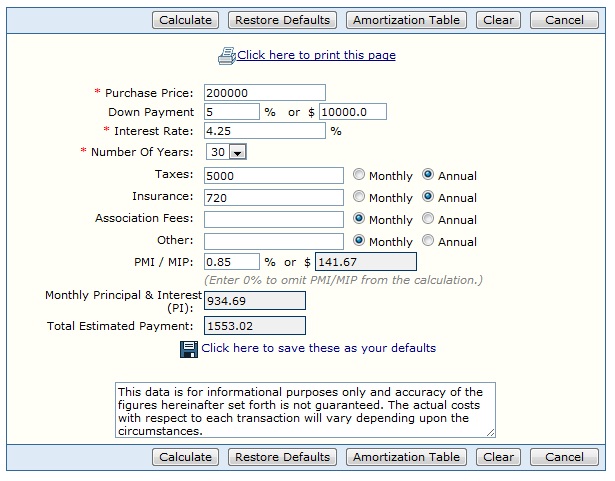
Example #2: Same as Example #1, except now let's say you're getting a 5% down conventional mortgage. So you'll change the down payment to 5%, and you'll have to add mortgage insurance. (For more info on what mortgage insurance is and how it's figured out, read
this article.) Today I'm using .85% for mortgage insurance, but this rate will vary depending on the borrower's credit score, amount of down payment, and market conditions. Enter .85% into the PMI / MIP field, which stands for "private mortgage insurance / mortgage insurance premium."
The calculator has also separated out the monthly mortgage insurance amount here. What a nice mortgage calculator.
Example #3: Now imagine the property in Example #2 is a condo with a monthly association fee of $150. Just enter $150 into the Association Fees field, make sure the MONTHLY radio button is selected, and the calculator will include this amount in the total estimated payment. I won't bore you with a screenshot of this one, you get the point.
Example #4: And for the grand finale, we will use an FHA loan. (For more information on what an FHA loan is and why it's different for this purpose, read
this article.) Use the same information from Example #2, except change the down payment to 1.75%, and change the PMI rate to 1.25%. The minimum FHA down payment is actually 3.5%, however there is an upfront mortgage insurance premium for FHA loans (separate from what is paid monthly) that can be rolled into the loan as opposed to being paid at the closing. With interest rates so low, it's extremely common in today's market to roll the upfront MIP into the loan. The upfront MIP rate is currently 1.75% of the loan amount, so in order to account for adding that amount to the loan balance, we're taking it off the 3.5% down payment. Here's the result:
So you can see, when comparing Examples #1, #2, and #3, the difference in the affordability of the payment depending on the amount of your down payment and the type of financing you're using.
Hopefully this article allows you to figure out what you can afford when looking at a purchase or refinance. Of course, you'll still need me to set you up with an MLS account and a good loan officer to fill you in on the latest changes in interest rates, mortgage insurance rates, and financing programs available - but this is a start!